Deconstructing David Chalmer's "Hard Problem of Consciousness"
The Myth of "Subjective Experience"

The Hidden Assumption Behind the Hard Problem
Few contemporary philosophers have influenced the discussion of consciousness more than David Chalmers. His famous “Hard Problem of Consciousness” asks why physical processes in the brain should be accompanied by subjective experience. Why is there “something it is like” to see red, feel pain, or hear music?
At first glance, this seems like a profound question. However, before we can ask why subjective experience exists, we must first examine the conceptual framework hidden within the question itself. The phrase “subjective experience” appears innocent, but it carries assumptions inherited from a long philosophical tradition.
The central assumption is that experience is fundamentally a relationship between a subject and an object: there is a subject who experiences, and there is an experience that belongs to that subject.
Yet both Buddhism and modern neuroscience have cast serious doubt on this picture.
If the notion of a subject is problematic, then the entire framework of “subjective experience” may need to be reconsidered.
The Buddhist Critique: The Illusion of Self
More than two thousand years ago, Buddhism launched one of the most radical critiques of human experience ever proposed.
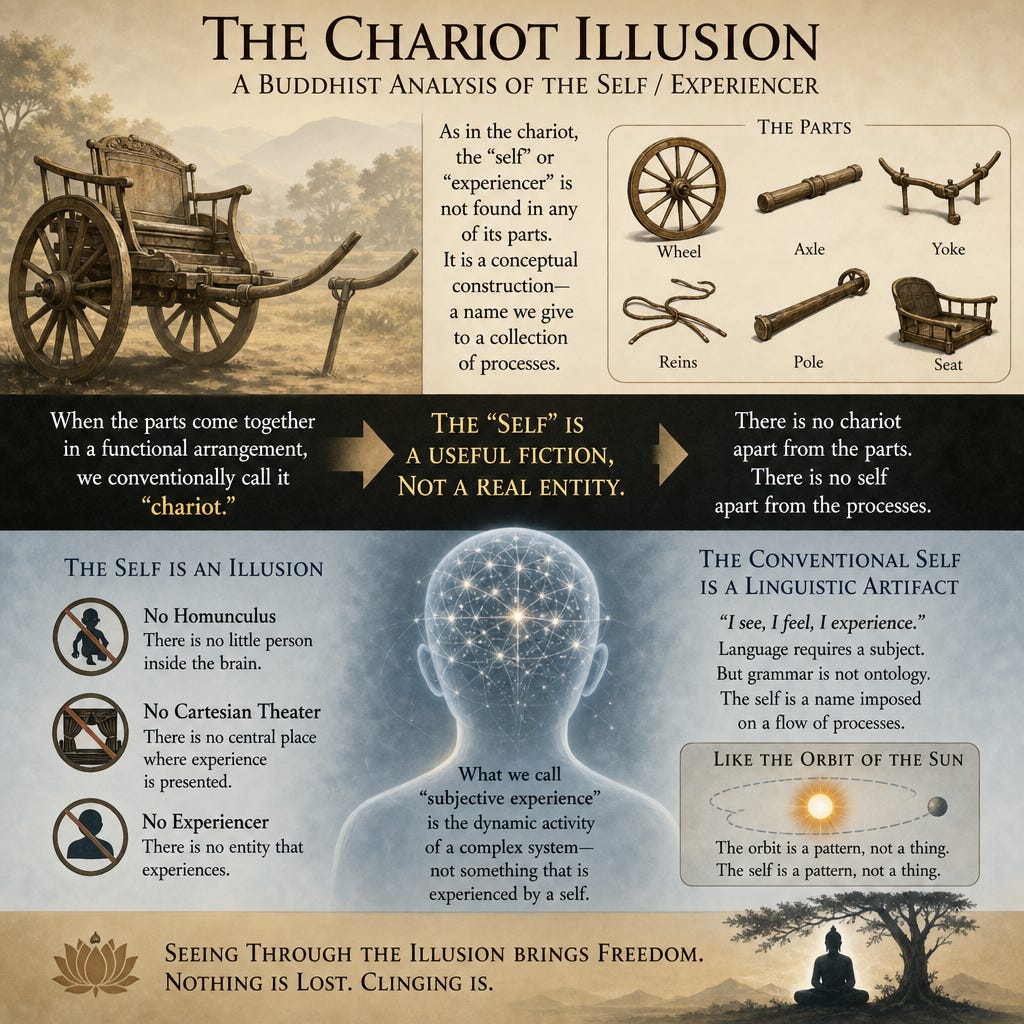
The doctrine of anatta (non-self) argues that what we call the self is not an independently existing entity. Instead, it is a conceptual designation applied to a constantly changing collection of physical and mental processes. The Buddha illustrated this with the famous simile of the chariot.
When we look at a chariot, we can identify its wheels, axle, frame, yoke, and other parts. Yet when we search for the chariot itself, apart from these components, it cannot be found.
The word “chariot” is merely a convenient label for a collection of parts arranged in a particular way.
The same analysis applies to the self.
We can identify sensations, memories, perceptions, emotions, thoughts, and bodily processes. But when we search for the self that supposedly owns these experiences, nothing can be found apart from the processes themselves.
The self is not an entity. It is a designation. It is a useful fiction.
Neuroscience Reaches a Similar Conclusion
Modern neuroscience has arrived at conclusions remarkably similar to those of the Buddhist analysis.
Three traditional assumptions have steadily been dismantled.
1. There Is No Homunculus
The intuitive picture many people hold is that somewhere inside the brain there exists a little observer who watches mental events.
This is often called the homunculus theory.
The problem is obvious. If there is a little observer inside the brain, then we must ask who is observing inside the observer’s brain. This leads to an infinite regress.
Neuroscience has found no such observer. Instead, it finds distributed networks processing information without any central witness.
2. There Is No Cartesian Theater
René Descartes imagined the mind as a kind of internal theater in which perceptions are presented to consciousness. Modern philosophers such as Daniel Dennett criticized this model as the “Cartesian Theater.”
No such theater has ever been discovered. There is no central screen upon which reality is projected. The brain consists of countless parallel processes occurring simultaneously across multiple regions.
Information is processed, integrated, and acted upon, but nowhere do we find a privileged location where everything comes together for a central observer.
3. There Is No Experiencer
Most importantly, neuroscience has never located an experiencer.
We find neural activity. We find sensory processing. We find memory systems. We find emotional regulation. We find self-models.
But we do not find an entity standing behind these processes and experiencing them.
The “experiencer” appears to be a cognitive construction rather than an independently existing reality.
The Chariot and the Orbit
The confusion arises because language often transforms abstractions into things.
Consider the orbit of the Earth around the Sun. The orbit is real in a descriptive sense. Scientists can calculate it with extraordinary precision. Yet the orbit is not a physical object floating in space. It is a pattern and an abstract model.
Similarly, the self is not a physical object hidden somewhere inside the brain. It is a pattern. It is a useful abstraction. The mistake occurs when we reify the abstraction and begin treating it as a concrete thing.
This is precisely what happens when we speak of an “experiencer.”
Just as there is no physical orbit apart from the Earth’s motion, there is no experiencer apart from the processes that generate the experience of selfhood.
The Problem of Subject-Object Metaphysics
At this point, defenders of Chalmers may object that his argument does not require a soul, a homunculus, or a substantial self.
This objection deserves serious consideration.
Chalmers could reasonably respond that his position requires only that experiences occur. Whether there is a permanent self behind those experiences is a separate issue. This is where the debate becomes more subtle.
The question is no longer whether there is a soul or an enduring self.
The question is whether the concept of “subjective experience” already presupposes a subject-object framework inherited from traditional metaphysics.
The phrase itself suggests that experiences belong to someone.
It encourages us to think in terms of a subject, an experience, and a relationship between them.
Yet both Buddhism and neuroscience suggest that this framework may be misleading.
The issue is not that Chalmers secretly believes in a soul. It is that the language of subjective experience may preserve assumptions inherited from older models of mind. We have been held hostage by our linguistic habits. Ludwig Wittgenstein famously wrote: "An entire mythology is stored within our language.”
Is “Subjective Experience” a Linguistic Artifact?
This raises a profound question. What exactly is meant by “subjective experience”?
Our grammar encourages us to assume that every verb must have a subject.
If there is seeing, we assume there must be a seer. If there is thinking, we assume there must be a thinker. If there is experiencing, we assume there must be an experiencer.
But this may simply be a linguistic habit rather than a metaphysical truth. Buddhist philosophy repeatedly challenges this assumption.
There is seeing, but no seer. There is hearing, but no hearer. There is thinking, but no thinker. There are processes, but no independent subject standing behind them.
The experience is not denied. What is denied is the existence of a separate entity that owns the experience.
This distinction is crucial.
The Buddhist critique does not deny appearances. It denies the reification of an observer behind the appearances.
From this perspective, “subjective experience” may be less a discovery about reality than a product of the way language organizes experience.
Rethinking the Hard Problem
The conventional model of consciousness assumes three things:
An observer
Experiences
A relationship between the two
But if the observer is removed, the framework begins to change dramatically.
The traditional picture resembles a theater: A self sits in the audience watching mental events unfold on an internal stage. Yet neuroscience finds no audience.
Buddhism finds no audience.
Both neuroscience and Buddhist philosophy find only processes.
This does not automatically refute Chalmers. However, it raises a deeper question.
Perhaps the Hard Problem arises not because consciousness is mysterious, but because we are still using conceptual categories inherited from an older worldview.
If the subject-object framework is mistaken, then the problem itself may require reformulation.
Instead of asking: “Why does a subject have subjective experiences?”
we may need to ask: “What processes give rise to the appearance of subjectivity in the first place?”
That is a very different question.
The Burden of Intellectual Inheritance
Human beings inherit concepts from earlier ages without recognizing the assumptions embedded within them.
Many of our most familiar ideas originated in ancient metaphysical systems that assumed souls, essences, and enduring selves.
Over time, these assumptions became so deeply embedded in language that they appear self-evident.
The concept of a subject who possesses experiences may be one such inheritance.
Like the geocentric universe, vital spirits, or Cartesian dualism, it may survive not because it has been demonstrated, but because it is built into the structure of ordinary thought.
The challenge is not merely scientific but philosophical.
We must learn to distinguish between what is observed and what is presupposed.
Conclusion
David Chalmers’ Hard Problem of Consciousness has stimulated important philosophical discussion. Yet its central concept—”subjective experience”—deserves closer scrutiny.
Both Buddhism and neuroscience challenge the assumption that there is a subject standing behind experience.
There is no homunculus.
There is no Cartesian Theater.
There is no identifiable experiencer.
What we call the self appears to be a conceptual abstraction, much like the Buddhist chariot or the orbit of a planet.
This does not prove that consciousness is an illusion.
Nor does it automatically refute Chalmers.
What it does suggest is that the Hard Problem may be framed within a conceptual structure inherited from subject-object metaphysics.
If the subject itself cannot be established, then the notion of “subjective experience” becomes far less straightforward than it first appears.
Before asking why subjective experience exists, we may first need to examine whether the conceptual framework that gives rise to the question is itself valid.